I Gave the Same Resume to ChatGPT, Claude and Gemini. Here's What Happened
I gave the exact same resume and prompt to ChatGPT, Claude and Gemini to see whether their advice would actually match. It didn’t - especially when it came to ATS compatibility and the level of jobs I should be applying for.
I've been putting off updating my resume for a while now, and last week I finally sat down to do it - except instead of actually fixing anything, I got distracted by a different idea: what if I just handed the old, untouched version to three different AI tools and saw what they came back with?
The resume in question wasn't exactly a masterpiece to begin with. I'd built it in about an hour using one of those ATS-friendly templates, made sure the basics were in there, and never really looked at it again. By the time I ran this test it was already stale - I'd started Tried, Actually since then, and none of that work had made it onto the page.
So the plan was simple. Same resume, same prompt, three tools: ChatGPT, Claude and Gemini. New conversation each time, no extra context, no follow-up corrections when they got something slightly wrong. I wanted to see whether three AIs looking at the exact same person would actually agree with each other, because if they didn't, that says something about how much weight to put on any single "AI resume review."
So which AI was actually best at reviewing my resume? ChatGPT came out on top in my test, scoring 93/100, with Claude close behind at 89/100 and Gemini at 73/100. The more useful finding, though, was where they agreed: all three thought my resume lacked measurable evidence, undersold my strongest content experience and gave too much space to unrelated logistics work.
How I tested ChatGPT, Claude and Gemini
Same three-page DOCX every time. Same prompt, word for word: act as a senior recruiter hiring for remote Content Marketing / Digital Marketing roles in Europe, give me a score out of 10, five strengths, five weaknesses, an ATS assessment, feedback on my positioning, what I'm underselling, vague claims that need evidence, stuff to cut, five priority fixes, what level of job this currently competes for, and three questions you'd ask before rewriting it.
One thing I was strict about: don't make anything up. If something wasn't in the resume, I wanted it flagged as missing, not politely assumed.
Here's what came back.
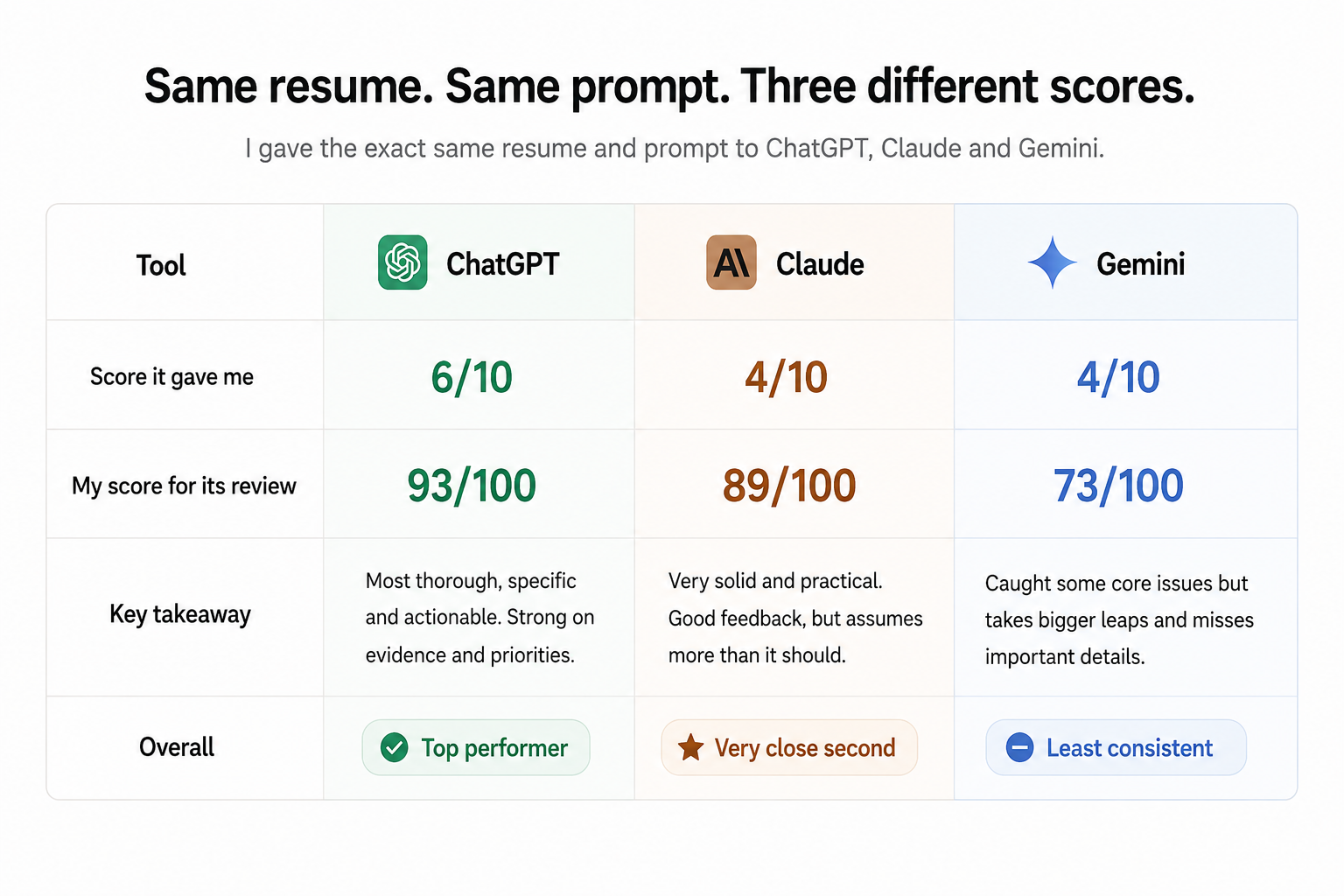
6 versus 4 doesn't sound like much of a gap on its own. It got more interesting once I actually read why they landed where they did.
Where all three agreed
Honestly, more than I expected.
The big one, unanimous across all three: no evidence anywhere. I'd managed things, developed things, coordinated things, created things - and apparently at no point did past-me think to mention what any of that actually produced. Fair enough. Looking back at it now I can see it too. My young.lv listing says I managed 7-10 freelance writers, planned editorial calendars, coordinated daily publishing. Fine detail, that team size - but how many articles were we actually putting out? How much of it did I write myself versus edit? None of that's in there.
ChatGPT was the most specific about this, asking for things like article volume, campaign numbers and audience size. Claude asked similar questions and pointed out, correctly, that basically every job on the page was written as a list of duties with no outcomes attached to any of them.
I don't have hard numbers for everything they wanted. Some of that data just doesn't exist anymore, and I don't even have login access to the old Alzorte accounts. But I do have more than what's currently on the page, so that's going in.
Second thing all three flagged: my logistics work is eating way too much space for someone trying to look like a content marketer. I'm not removing it - it happened, it's real, I'm not pretending otherwise - but it doesn't need the same level of detail as the actually relevant stuff.
Which also means my Reach Truck, EPT, Stacker and Combi Truck certifications can probably sit this one out. Three years of forklift training and I still can't quite believe none of it is coming with me.
Claude put this best, I thought - not "delete the irrelevant stuff" but "figure out how much space it actually deserves given what this document is for." That's the framing I'm going to use.
Third: my best material was buried in boring bullets. Alzorte especially - six-plus years running my own translation and content business, and the whole thing gets summed up as "built and maintained the website, worked with Facebook, Instagram and SEO-oriented content, handled clients." No scale, no sense of what any of it amounted to.
Same story with young.lv. All three tools landed on this independently enough that I'm treating it as real, not just one model's taste.
Where they completely disagreed: ATS compatibility
This is the part that made me trust none of them fully.
I'd built the resume in an ATS-friendly format on purpose, so I specifically wanted this checked. ChatGPT put it around 8/10 technically - single column, standard headings, normal paragraphs and bullets, no tables, no text boxes. Claude said basically the same thing: technically clean, should parse fine, though it flagged some separate issues around keyword matching and inconsistent dates.
Gemini said parsing risk was high.
Its reasoning was mostly that warehouse/logistics terms sitting next to marketing terms would confuse things. And sure - I get why mixing "WMS" and "content strategy" on the same page is bad for relevance. What I don't buy is that this is the same thing as an ATS failing to parse the document.
Those are different problems: can the software extract the text, does the text match the right keywords for a given job, and does a human reading it think I'm applying for the wrong role? They can overlap. They're not the same question.
If Gemini had been the only tool I used, I probably would have gone and rebuilt the entire format, assuming something structural was broken.
It wasn't.
And that's probably the point in this experiment where I stopped wondering which AI was "right" and started thinking I needed to review the reviews too.
Apparently I'm junior and mid-level, simultaneously
They couldn't agree on career level either.
ChatGPT thought the underlying experience was mid-level, just poorly presented, and suggested titles like Content Marketing Specialist or Content Manager. Claude was more cautious, landing on entry-to-mid or junior Content Marketing Specialist. Gemini went further junior still - Content Coordinator, that range.
I know which answer I'd like to be true. That's not really a scoring method though.
The difference mostly came down to what each tool paid attention to. ChatGPT weighted the editorial leadership and business ownership more heavily. Claude and Gemini weighted the lack of recent, dedicated marketing work and the total absence of measurable results.
And that gives me something I can actually use. I don't particularly need an AI to decide whether I'm officially "junior" or "mid-level". I need the resume to make the relevant experience obvious enough that a recruiter doesn't have to dig for it.
Scoring the reviews themselves
I didn't want to just pick whichever tool flattered me most, so before comparing anything I set up rough criteria: specificity, accuracy, actionability, how well it prioritized, ATS/recruiter usefulness, whether it made things up, positioning and general judgment.
Nothing scientific - just a way to keep myself somewhat honest across three very different-sounding reviews.
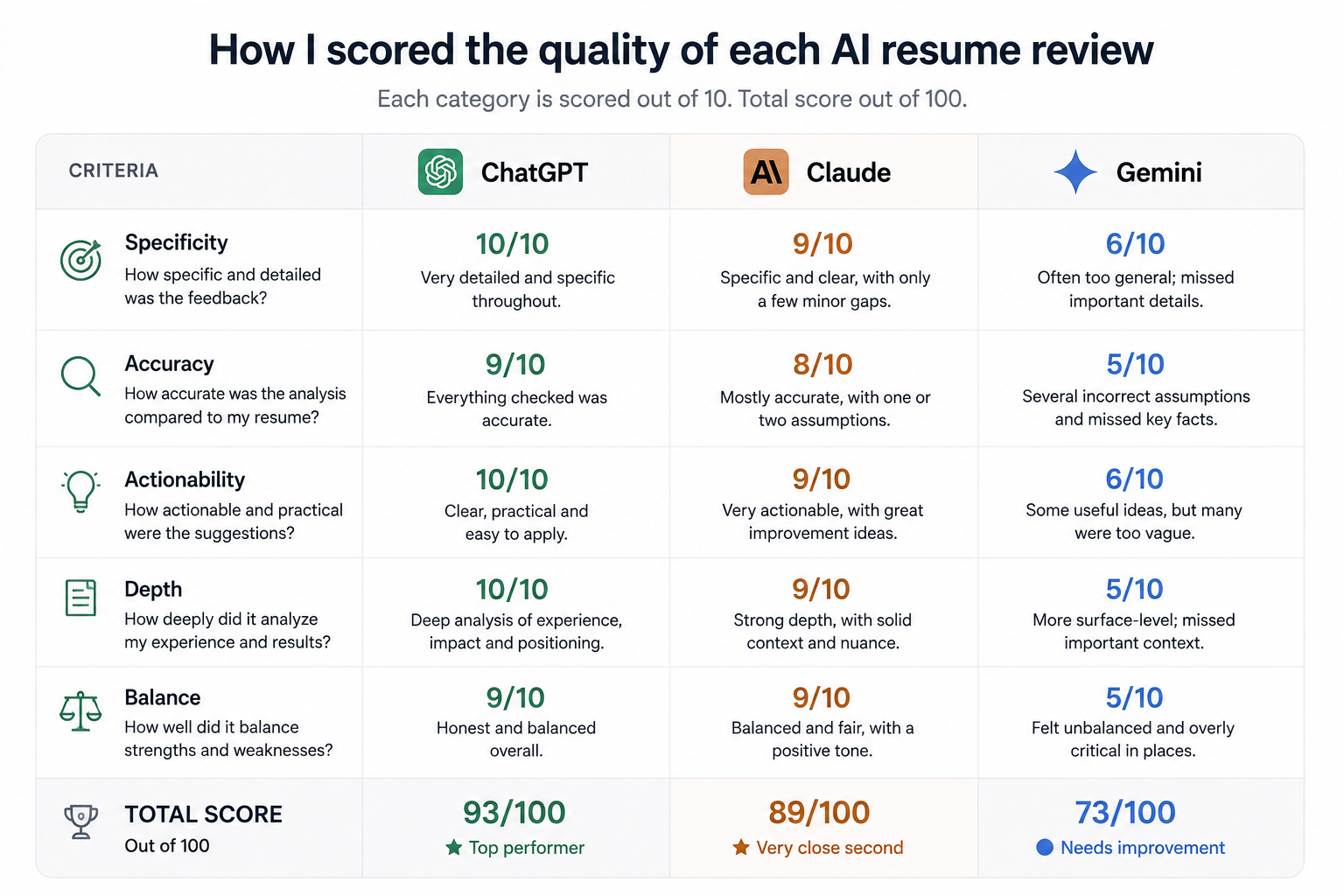
ChatGPT came out ahead for me, Claude close behind, Gemini a fair bit further back.
ChatGPT won mostly on specificity. "Add metrics" is easy advice that means nothing. Asking whether I could recover monthly article counts, client numbers or audience size gave me an actual list to go chase down.
It also asked whether I had newer projects, websites or portfolio work that hadn't made it into the document - which, yes, obviously, that's the entire reason I built Tried, Actually.
Claude did one thing better than ChatGPT though: its handling of the irrelevant work felt more like reasoning through an actual person's messy career rather than optimizing an imaginary perfect one.
It lost some points from me for one specific overreach - it assumed my "Store Manager (Current)" role had ended once the logistics work started, which isn't actually stated anywhere in the resume. Small thing, but I'd specifically asked for no assumptions, so it counts.
Gemini wasn't useless. It caught most of the same core issues, but it made a couple of confident leaps I wasn't comfortable with.
Calling the gap between my Marketing Director role, which ended in 2019, and now a "6-Year Marketing Gap" is one of them. Alzorte ran until 2023 and the resume already says that work included website management, social promotion and SEO content.
You can reasonably say that work wasn't dedicated or visible enough. That's fair. Calling it a six-year gap isn't quite the same claim, and it's the kind of thing I'd explicitly told all three not to do.
So, is AI actually useful for reviewing a resume?
Yeah. Just not the way I assumed I would use it going into this.
I don't think "AI, is my resume good?" is actually a useful question to ask, because the answer clearly depends on which AI you ask and how it happens to weigh things that day.
A score of 4 versus 6 out of 10 looks precise. It isn't.
Same with career level - one model calling me junior doesn't make it true any more than another calling me mid-level does.
What I would do again is run the same resume through multiple tools and pay attention to where they agree. All three, independently, told me I had no evidence behind many of my claims. Going to fix that. All three thought young.lv and Alzorte deserved way more space than they got. Fixing that too.
All three thought the logistics work was crowding out the story I actually want to tell - and honestly, of everything, the forklift certifications leaving my CV is the change I'm least going to mourn.
Where they disagreed - ATS risk, career level - I'm not going to pick my favourite answer and move on. That's where I'll check things myself instead of trusting whichever AI happened to sound the most confident.
Next up: actually rewriting the thing. Which mostly means digging up whatever real numbers I can still stand behind, giving the content and editorial work room to breathe, shrinking the unrelated jobs down to a line or two each, and finally adding Tried, Actually somewhere it can be seen.
The forklift certifications, meanwhile, are officially retired. They had a good run.