Am I Overpaying for Everyday Shopping? I Compared the Same Basket Across 7 German Stores
I compared the same 30-item shopping basket across seven German retailers to see how much I could actually save - and whether shopping around was worth the extra effort.
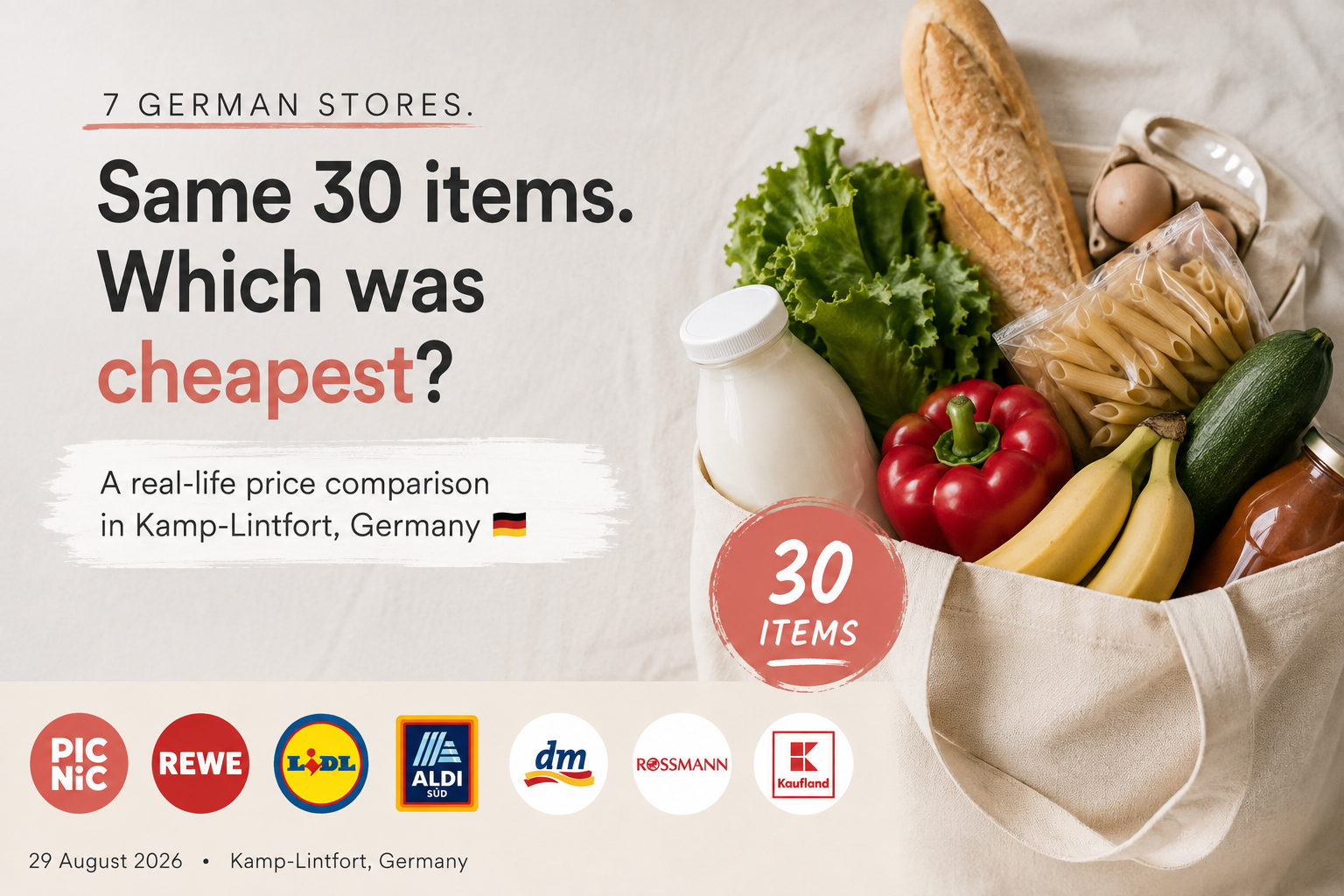
I compared the same 30 everyday items across Aldi Süd, Lidl, Kaufland, REWE, Picnic, dm and Rossmann. The theoretical cheapest combination came out to €45.48. The same 30-item basket from Picnic came to €68.74 - a difference of €23.26, or about 51%. But getting the €45.48 price would mean shopping at all seven retailers in the same week.
So yes, technically I could save quite a bit. Whether I actually want to is another matter entirely.
Why I bothered testing this
Having a kid made me a lot more aware of all the small, repeated costs that quietly pile up. There's always something to restock: diapers, wipes, food, household stuff. You buy a pack of something and five minutes later, somehow, you need another one. I'm fairly convinced diapers should just grow on trees given how fast we go through them.
The annoying part is that "just buy whatever's cheapest" isn't always practical advice. Not every diaper fits every kid the same way, and not every baby snack or pouch gets eaten. Once you know a product actually works for your family, swapping it out to save a few cents can easily mean buying the original one anyway.
I'm raising my son on my own, so saving money where it makes sense matters to me. But I also don't want grocery shopping to turn into a second job. What I wanted to know was pretty simple: am I constantly overpaying for normal groceries and household stuff just because I buy them wherever it's convenient? And if I am, how much could I realistically save?
Building a 30-item basket
I wanted the basket to look like something I'd actually buy, not a random assortment of products chosen because they were easy to compare. So I settled on 30 items across four categories: food, baby products, dog products and household essentials.
The food side included lactose-free milk, eggs, butter, yogurt, oats, bread, spaghetti, rice, potatoes, fruit and vegetables, chicken breast and Tilsiter. For baby products I went with Pampers pants, Pampers wipes, a fruit pouch, Maisstangen and baby bath and shampoo. Then I added dog food and treats, toilet paper, laundry detergent, washing-up liquid, cleaning products, bin bags and kitchen paper.
Some of the specifications were deliberately narrow. I compared Pampers specifically rather than "the cheapest diapers available", because the cheapest diapers wouldn't actually help me. Same with lactose-free 1.5% milk, parboiled rice, regular spaghetti and three-ply kitchen paper. I wasn't trying to build the cheapest imaginable basket. I was trying to price the basket I would actually buy.
The rules came before the prices
This mattered because it would've been very easy to accidentally influence the result without meaning to. Before checking the prices, I locked in the products, quantities and rules.
I used regular prices rather than temporary promotions or personal coupons. Where package sizes differed between stores, I converted everything to the same unit: price per kilogram, per 100 wipes, per diaper or per wash. If a comparable product wasn't available somewhere, I didn't replace it with something completely different just to fill the table.
I checked prices for 47475 Kamp-Lintfort on 29 August 2026 wherever local prices were accessible. A large part of the data came from retailer websites and apps. For gaps where a retailer didn't make its prices easy to find online, I used public price data from SupermarktCheck. That does come with a limitation. SupermarktCheck uses user-submitted prices, so those entries aren't the same as me standing in a specific store and checking the shelf price that day.
So no, this isn't an official German supermarket price index. It's my shopping experiment based on the prices I could actually find.
Comparing prices online is more annoying than it sounds
I expected collecting the prices to be the boring part. Turns out, even finding out what something costs isn't particularly straightforward. Some retailers make prices easy to find. Others show promotions but not the regular local price. Products appear in one catalogue and not another, and package sizes vary a lot between stores. Picnic was by far the easiest place to build the basket. I found all 30 products there.
Here's how much of the basket I could compare at each retailer:
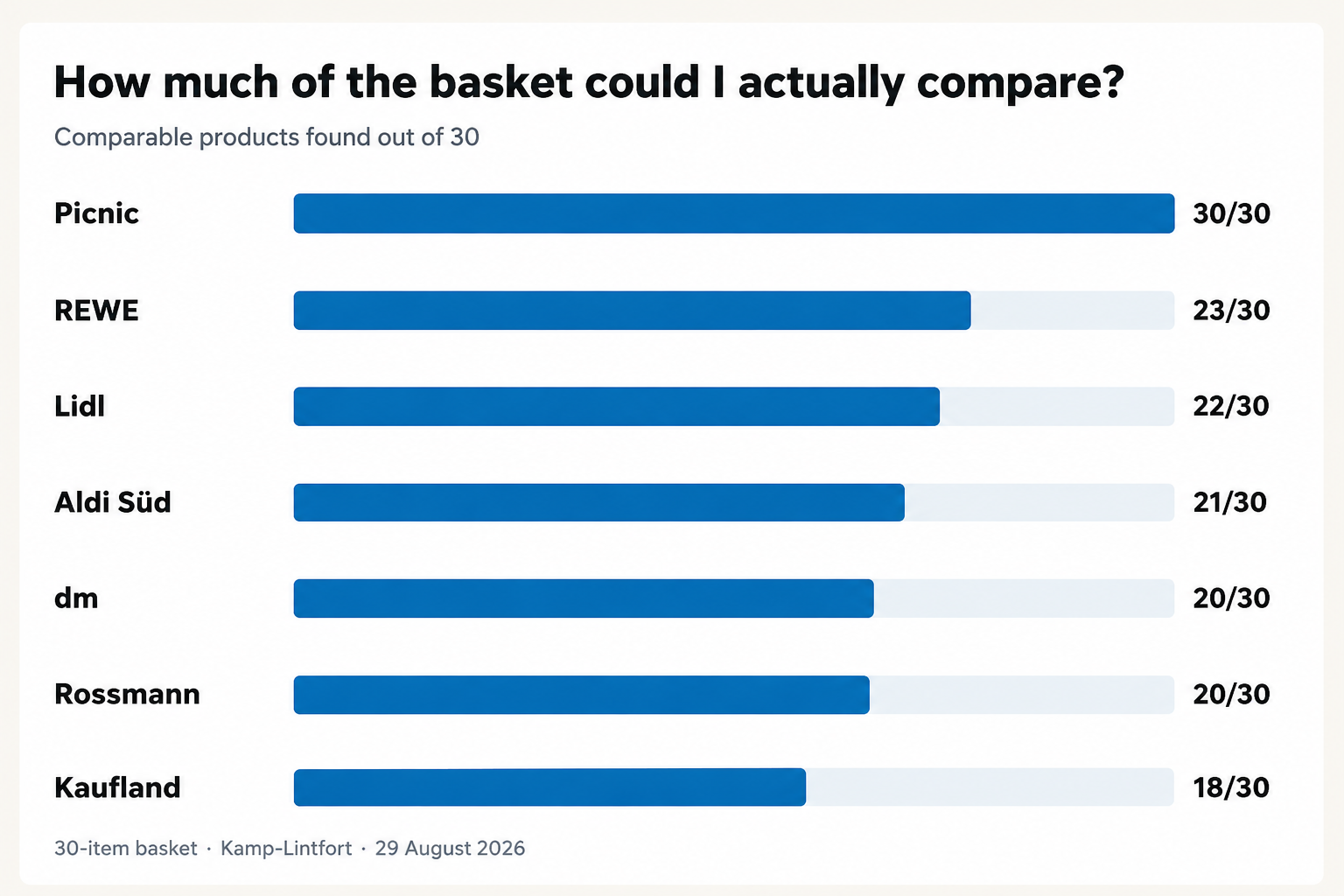
The dm and Rossmann numbers aren't particularly surprising because they aren't full supermarkets. I included them because I regularly buy household, baby and dog products there, and I wanted to know whether doing that actually makes financial sense.
The gaps at the other retailers still made a simple store-by-store comparison difficult. Picnic was the only retailer where I could build the full 30-item basket from the data I found, while the others were missing at least some comparable products.
So instead of pretending I could rank seven complete supermarket baskets, I calculated something more useful: what the same 30 items would cost if I bought each one wherever its comparable unit price was lowest. Then I compared that theoretical minimum with the complete 30-item basket I could build at Picnic.
The cheapest basket was €45.48
After standardising the quantities, the theoretical cheapest version of my 30-item basket came to €45.48. It's a standardized basket value, not necessarily the amount I would physically pay at seven checkouts.
If one shop sells 62 diapers and another sells 102, for example, comparing the price of the packages tells me very little. So I compared the equivalent cost for the same number of diapers. I did the same with wipes, detergent, dog food and products sold in different weights. That lets me answer "which product is actually cheaper?" without letting package size distort the result.
And €45.48 looked pretty good until I looked at where all those cheapest products came from. Aldi for one thing, Lidl for another, Kaufland, REWE, dm, Rossmann and Picnic.
All seven stores.
At that point my theoretically brilliant money-saving strategy started to look slightly ridiculous.
Then I compared it with Picnic
Picnic was the only retailer where I could build the complete 30-item basket from the prices I found, so it gave me a useful comparison with the theoretical cheapest combination.
For the same 30 items:
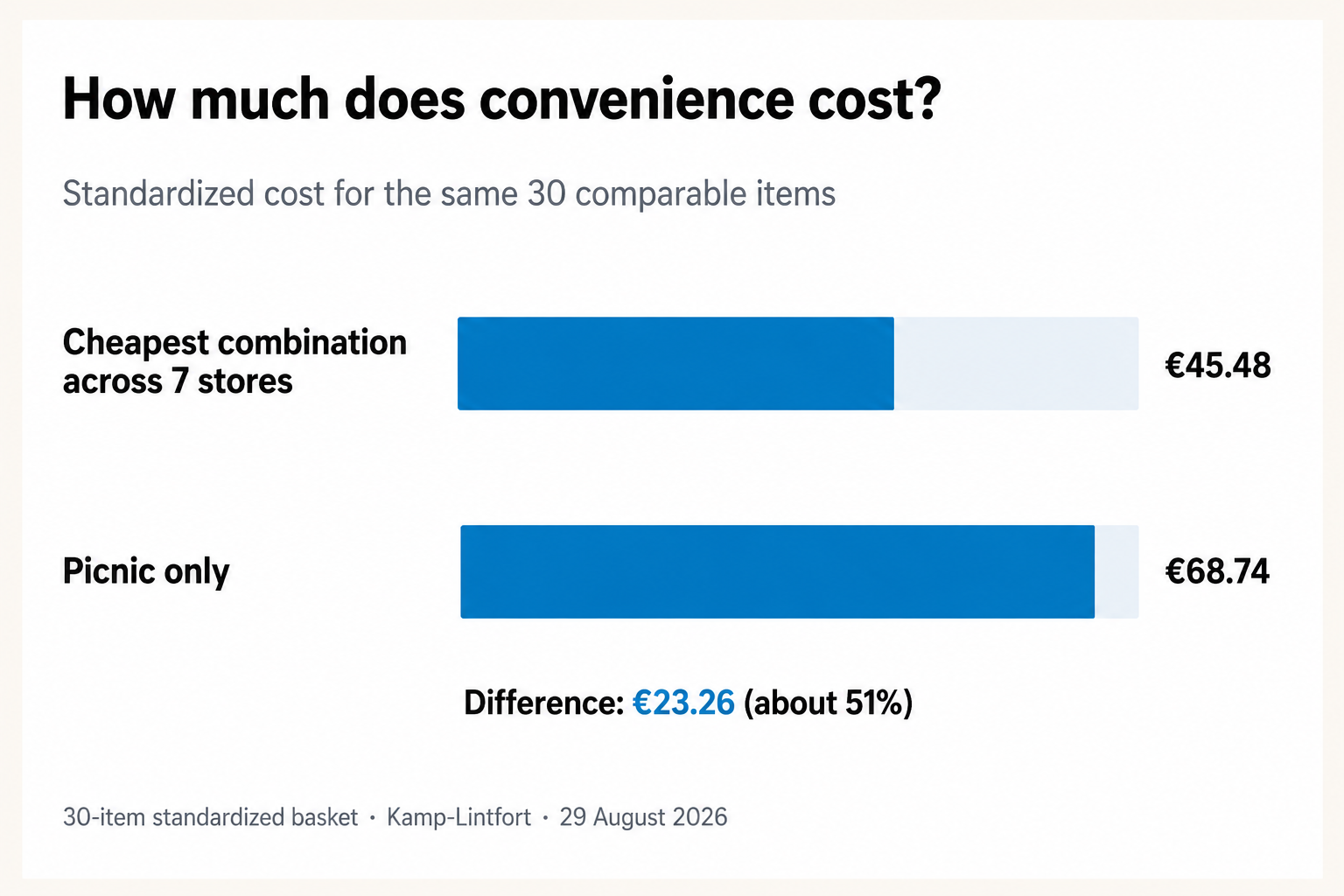
That's roughly a 51% difference.
€23.26 isn't nothing. If the same difference happened every week, theoretically that's about €1,200 over a year. But I am absolutely not going to seven different shops every week.
I have a kid, a dog, work and enough things to do already. Spending half a day going from shop to shop for cheaper spaghetti, milk and toilet paper doesn't sound like saving to me. That changed how I looked at the €23. Some of it is money I could potentially save. Some of it is simply what I'm paying for convenience.
Some price differences are hard to ignore
There were still individual products that made me think I should pay more attention. Our lactose-free 1.5% milk, for example, ranged from €0.89 at Kaufland to €1.99 at Rossmann in the prices I checked. That's more than double for something I buy regularly.
Pampers wipes were another good example of why looking at the package price isn't enough. A bigger pack can look much more expensive until you calculate the actual cost per wipe. Laundry detergent was the same. Comparing a €2 bottle with a €3 bottle doesn't tell me much if one gives me 20 washes and the other gives me 40.
Am I going to another shop because a cucumber costs 30 cents less there? No. But if I notice that several things I buy all the time are cheaper at the same store, then it starts making sense to change where I buy that part of my shopping.
So, is shopping around actually worth it?
For me, yes, to a point. The absolute cheapest version isn't realistic. Saving the maximum would require buying from seven different retailers, and I don't have the time or desire to do that every week. But €23 is also too much of a difference for me to completely ignore.
I don't need to find the cheapest tomato in Kamp-Lintfort. I can, however, pay attention to the things we go through constantly. I can buy household products when I'm already at the store where they're cheaper. I can look at the price per diaper instead of just comparing the big numbers on two packages.
Basically, I can steal the useful parts of my ridiculous seven-store shopping plan without actually doing the ridiculous seven-store shopping plan.
I started this because I wanted to know whether convenience was quietly costing me money. Apparently, it is. Now I know roughly how much.